
How to Organise Your Pantry
12 min reading time
12 min reading time
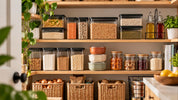
An organised pantry can completely change how your kitchen feels and functions. When ingredients are easy to see, easy to reach and easy to replenish, everyday cooking becomes more efficient and grocery shopping becomes more intentional. Whether you have a dedicated pantry, a kitchen cupboard, open shelving or a few cabinets for dry food storage, the goal should be the same: create a system that makes everyday life easier.
For many households, pantry organisation begins with the intention to make the space look neater. While appearance matters, a truly useful pantry should do more than look attractive. It should help you find what you need quickly, understand what is running low, reduce duplicate purchases and make better use of available storage space.
This guide explains how to organise your pantry in a practical way, with ideas for food storage containers, storage jars, pantry organisation and kitchen storage that work for real homes.
Before buying storage containers or reorganising shelves, take everything out and look at what is actually in your pantry. This is often the most revealing part of the process.
You may find several unopened packets of the same ingredient, products hidden behind larger items or foods you had forgotten were there entirely. You may also notice that some ingredients are stored in places that make little sense for how often you use them.
Start grouping items into broad categories such as rice and grains, pasta and noodles, cereals and breakfast foods, baking ingredients, snacks, sauces, canned foods, spices and everyday cooking essentials. At the same time, check expiry dates and remove anything that should no longer be kept.
Once everything is visible, you can begin to understand what kind of storage your pantry actually needs. This is a much better starting point than buying a large collection of matching containers without knowing whether they suit your household.
The strongest pantry organisation systems are built around actual habits, not just aesthetics.
A pantry becomes easier to maintain when products are positioned according to how often they are used.
Items you reach for every day should be the easiest to access. Ingredients used less frequently can sit higher up or further back. If you prepare breakfast every morning, it makes sense to keep cereals, oats, coffee and tea close together rather than spreading them across different shelves.
The same applies to cooking ingredients. Rice, pasta, flour and frequently used seasoning should sit in logical zones so you are not moving across the kitchen every time you prepare a meal.
Think about your pantry as a series of small areas rather than one large storage space. You might have a breakfast zone, a baking zone, a cooking zone and a snack zone. Families may also find it useful to create a section specifically for children’s snacks or smaller food portions.
This kind of zoning makes pantry organisation easier because every product has a reason for being where it is.
Food storage containers are useful because they can make dry ingredients easier to organise, stack and monitor. However, they should solve a practical problem rather than simply replace attractive packaging with other attractive packaging.
Rice, flour, sugar, cereals, pasta and similar dry foods are often sold in flexible packaging that can collapse, spill or take up more space than necessary. Moving suitable ingredients into structured food storage containers can make shelves easier to manage and allow you to see stock levels more clearly.
For everyday pantry storage, products such as the OMADA Round Pull Box Set of 2 and OMADA Square Pull Box Set of 3 can be useful for ingredients that are purchased regularly and need a defined storage space.
If you prefer a more coordinated pantry setup, the Brabantia Rectangular Tasty+ Stackable Canister Set of 3 and Brabantia Tasty+ Stackable Canister Set of 3 provide a more consistent storage format.
The key is to choose container sizes that match the amount you normally buy. Large containers are useful for high volume staples, but an oversized container can waste valuable shelf space if it is rarely filled.
Storage jars work especially well for pantry organisation because they combine visibility with structure. They are particularly useful for ingredients that are bought in moderate quantities and benefit from being kept together in a consistent format.
Clear jars can make it easier to see what is inside and how much remains. This is particularly useful for foods such as pasta, grains, cereal, snacks and other suitable dry ingredients.
Within Napev’s Pantry Reset range, the Paşabahçe Woody Jar 757ml and Paşabahçe Woody Jar 1L are strong examples of products that can be used to create a more organised shelf while still making contents easy to identify.
Smaller jars also have a place in an organised pantry. Products such as the Kilner Round Clip Top Jar or the Brabantia Tasty+ Stackable Canister, Set of 2 can work well for ingredients that do not require a large container.
The important thing is to avoid using one container size for everything. Good pantry storage usually includes a mixture of large, medium and small containers because ingredients are purchased and used in different quantities.
Some parts of the pantry deserve their own zone because they are used frequently or contain many smaller items.
Breakfast is a good example. If cereals, oats, coffee and tea are used every morning, keeping them together can reduce unnecessary movement around the kitchen and make the start of the day more efficient.
A product such as the Brabantia Coffee Pad Canister can be useful for creating a dedicated place for coffee pads or related breakfast items.
Baking ingredients are another category worth grouping separately. Flour, sugar, baking powder, cocoa and other baking products can easily become mixed with general cooking ingredients if they do not have a clear area.
The Mason Cash In The Meadow Storage 1.85L and Mason Cash In The Meadow Storage 2.5L can be used for suitable ingredients where dedicated baking storage is helpful.
Spices are often one of the easiest things to lose in a pantry because the containers are small and can disappear behind larger products. A dedicated spice section makes them easier to see and can help prevent duplicate purchases.
The Tabletops Revolving Spice Rack 6pc gives selected spices a clear, accessible place and works well as a practical pantry organiser.
Visibility is one of the most important principles in pantry organisation.
When ingredients are hidden, they are more likely to be forgotten. This can lead to duplicate purchases, unnecessary waste and food expiring before it is used.
Try to avoid placing smaller products behind much larger ones. If your shelves are deep, consider arranging products so that labels and contents are visible from the front. Transparent storage containers and jars can also make it easier to monitor stock levels at a glance.
High volume staples such as rice, cereal or flour may benefit from larger storage solutions. The Brabantia Tasty+ Stackable Canister 5.4L is one example that can suit households buying selected ingredients in larger quantities.
Large containers are most effective when they reflect the amount you actually use. If you regularly buy a particular ingredient in bulk, larger storage makes sense. If not, smaller containers may keep the pantry easier to manage.
A pantry organisation system should reflect all the types of food and kitchen essentials your household uses.
Cooking oils, small bottled ingredients, children’s food portions and prepared foods may need different types of storage.
For smaller bottled ingredients, the Kilner Set of 2 Oil Bottles & Metal Rack 0.3L can help create a dedicated and more organised area.
Families with children may also want a separate section for smaller portions or snacks. The Kilner Set of 6 Kids Jars 190ml can be useful in creating a defined space for those items.
Food storage also continues beyond the pantry. Leftovers, prepared ingredients and opened foods often need to move into the refrigerator or freezer. Products such as the Pyrex Cook & Freeze 0.6L Round Dish with Lid or OMADA Pull Box Glass Container - Teal can support a wider kitchen organisation system.
This is where pantry organisation becomes part of a broader approach to kitchen storage rather than an isolated shelf styling project.
One of the most common pantry mistakes is filling every available space simply because it exists.
A pantry needs breathing room.
You should be able to remove products and return them without rearranging an entire shelf. Leaving some space also makes it easier to accommodate new groceries without destroying the organisation system.
An overcrowded pantry quickly becomes difficult to maintain, regardless of how attractive the containers are.
Empty space is not wasted space. In a well organised pantry, it gives you flexibility and makes the system easier to use.
Pantry organisation can also help reduce waste.
When restocking ingredients, move older products towards the front and place newer products behind them where practical. This encourages you to use existing food first.
The same principle can be applied when you have more than one unit of the same ingredient.
Before grocery shopping, take a quick look through the pantry. An organised space makes this much easier because products are visible and grouped logically.
This simple habit can reduce duplicate purchases and help you use what you already have before buying more.
The best pantry is not the one that looks perfect on the first day. It is the one that stays organised several weeks later.
That means avoiding systems that are too complicated.
If decanting every single packet feels unrealistic for your household, do not do it. Use containers where they genuinely improve storage and keep other products in their original packaging.
If labels help you, use them. If they add unnecessary work, simple zoning may be enough.
The objective is to create a pantry that feels intuitive. Everyone in the household should be able to understand where products belong and return them to the same place.
Once the pantry is organised, maintenance should take only a few minutes.
During your Weekend Reset, return misplaced products to their proper zones, move older foods forward, check which staples are running low and wipe down shelves where necessary.
This keeps small amounts of disorder from becoming a much larger job.
Over time, you will also learn which parts of the pantry work well and which areas need adjusting. You may discover that one category needs a larger container, another needs to move to a lower shelf or a particular storage solution is no longer useful.
A pantry should evolve with the household using it.
If you are looking for food storage containers in Ghana, pantry storage jars in Ghana, Napev’s Pantry Reset brings together practical options for improving food storage and everyday kitchen organisation.
Start with the parts of your pantry that create the most frustration.
Choose storage according to what you actually buy.
Keep your most frequently used foods within easy reach.
Group similar ingredients together.
Leave enough space for the system to remain flexible.
The aim is simple: create a pantry that is easy to see, easy to use and easy to maintain.


GH₵59.00 - GH₵286.00


GH₵91.00 - GH₵143.00


GH₵531.00


GH₵180.00 GH₵162.00


GH₵206.00 GH₵185.00


GH₵140.00


GH₵2,327.00 GH₵1,977.95


GH₵59.00 GH₵50.00


GH₵43.00


GH₵957.00

Subscribe to our emails